Key Words:
Sukhothai period: Former Kingdom of Thailand located in North-central Thailand established from 1238 to 1438 when local Thai governor Pho Kun Bang Klang Hao (name later changed to Sri Indraditya) revolted against Khmer Rule alongside Thai nobleman and ally Pha Mueng. At its peak, the Sukhothai Kingdom was a small kingdom with elegant temples, monuments, and waterways that heavily affected the Thai culture we see today.
Viharn/Vihara- A Buddhist Monastery or temple usually serving as a worshipping space for monks
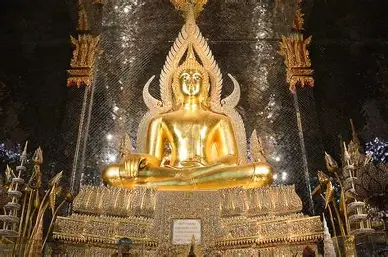
Phra Buddha Chinnarat: also known as the “King of Victory”, it is renowned for being one of the most beautiful Buddha images in Thailand, cast as a 375-centimeter bronze Buddha in 1357 during the late Sukhothai period. This Buddha image holds immense cultural significance to Thai people; it is believed to bring good fortune and protection.
Theravada Buddhism- Also known as the ‘Doctrine of Elders’, it is one of the oldest surviving forms of Buddhism and follows the Pali Canon scriptures, emphasizing individual enlightenment through moral conduct, meditation and wisdom. This form of Buddhism is dominant in regions like Sri Lanka, Myanmar, Thailand, Cambodia and Laos.
Siddhartha Gautama- also known as ‘The Buddha’-was an ancient Indian philosopher who founded Buddhism
(Fun fact! – The name Sukhothai comes from Sanskrit, translating to “Dawn of Happiness,” with ‘Sukha’ meaning happiness or good fortune and ‘Uthai’ meaning dawn or sunrise)
Introduction-
I just had to make this blog because I’ve always admired the art style I saw in the Viharn, I feel like this temple expresses their art in several creative forms, whether it be the murals you find on the wall or the Buddhas, or the ruined artillery you’d find when you explore another area of the temple. I think seeing the Phra Buddha Chinnarat in real life for the first time really amazed me. And most importantly, this is only one of many temples that truly showcase the beauty of Buddhism, and I’ll tell you why later! So, I hope you enjoy this blog as much as I do because this hit close to home for me 😀
Historical Background-
Wat Phra Sri Rattana Mahathat, also known locally as ‘Wat Yai’ (Big temple) is a significant Buddhist temple located in Phitsanulok, Thailand (North of Thailand), and it was founded in 1357 by King Lithai (also known as Maha Thammaracha I) of the Sukhothai Kingdom. Maha Thammaracha I was a dedicated scholar of Buddhism and founded this temple to strengthen Theravada Buddhism in the region. This temple was and continues to be used for merit-making, religious ceremonies for Buddhist worship, and housing important Buddha images like Phra Buddha Chinnarat,
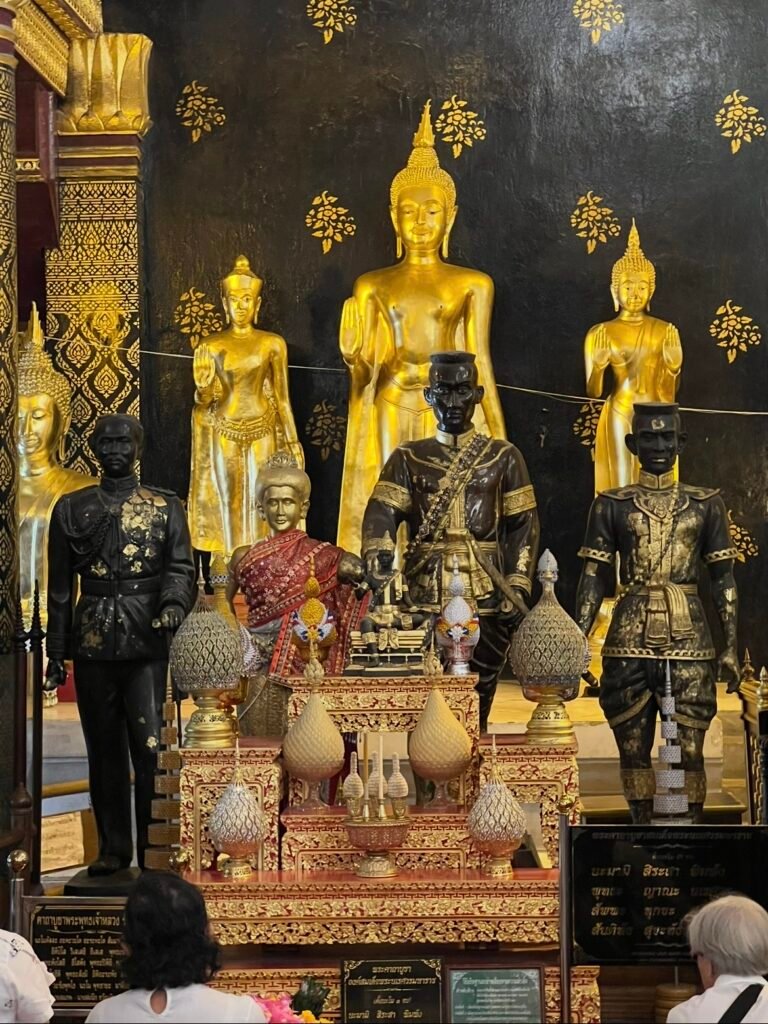
However, this temple was also created for political purposes, As Phitsanulok was an important city on the east of the Sukhothai kingdom, by having a royal temple in Phitsanulok, it would re-enforce the idea that Maha Thammaracha I was a protector of Buddhism and would legitimize his rule and reinforce his control over the region, This was important as Thailand was an aristocratic monarchy before, Which meant that nobles shared power over land and manpower, if Maha Thammaracha I didn’t have the support of aristocratic nobles, it can cause civil conflict and nobles would support a new heir to the throne. Another feature of the temple is the shrine housing the statues of King Naresuan the Great, His sister Suphankanlaya, and Prince Ekathotsarot, which is located near Phra Buddha Chinnarat. The statue was placed there as a symbol of liberation, as King Naresuan is celebrated in Thailand for liberating the country from their struggle for independence from invasion in 1593.
Architecture and relation to Buddhism-
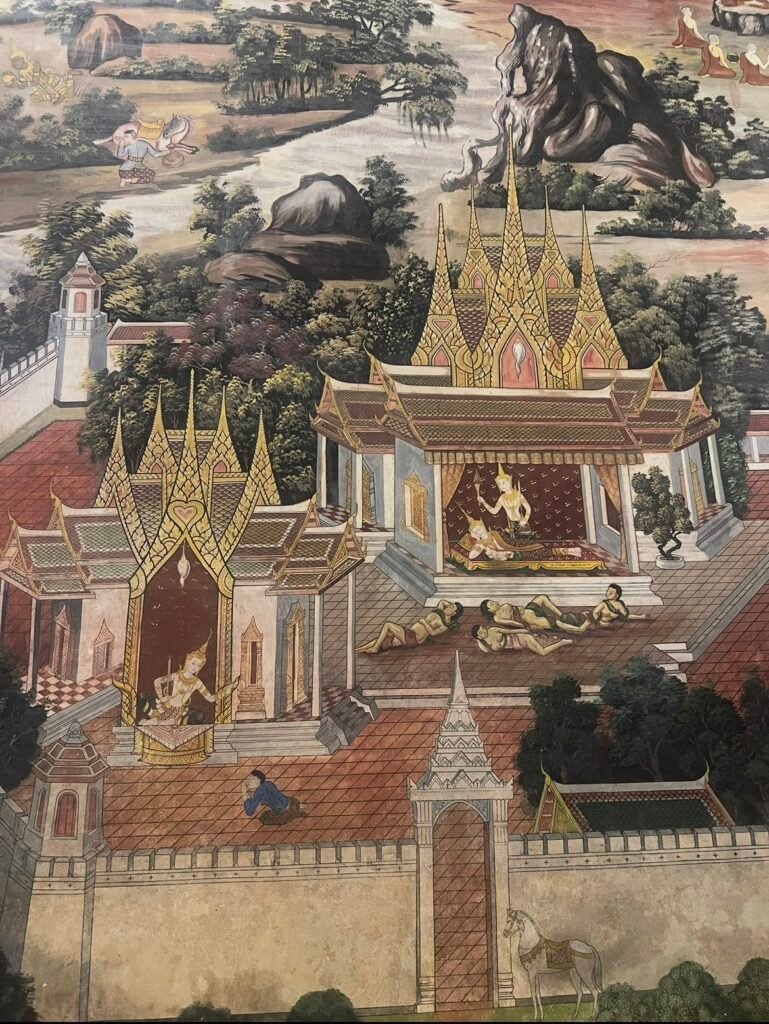
So how does this temple show off the beauty of Buddhism? Well, the Temple’s architecture blends the Ayutthaya-style prang (tower) and the Lanna-style Viharns. Ayutthaya and Lanna were both very important kingdoms in Thai history, and it just makes the temple more beautiful as it shows how Buddhism can be expressed in different art forms, but when blended, they complement each other and offer a vibrant atmosphere while staying true to Thai culture. Another way this temple depicts Buddhism is through its murals (see above). While not obvious, the murals show scenes from the Life of Buddha, where this specific scene shows Siddhartha Gautama observing the sleeping palace attendants before he leaves his royal life to seek out a path to liberation after witnessing suffering. Furthermore, the blend of Lanna and Ayutthaya-style architecture and use of murals offer a way to teach the way of Buddhism to people who don’t usually read scriptures, making Buddhism accessible to anybody who visits the temple, but furthermore makes Buddhism so beautiful by being present in Thai history, whether it be documented in Temples or seen in average Thai life.
References:
A History of the Sukhothai Kingdom | Thairanked
Sukhothai kingdom | Thai Empire, Ramkhamhaeng, Theravada Buddhism | Britannica
▷ What does Sukhothai mean in English? |
The Most Beautiful Buddha Image: Phra Buddha Chinnarat In Thailand’s Wat Phra Si Rattana Mahathat
Maha Thammaracha I – Wikipedia
Leave a Reply